
What a Mingo Property Value Means
A Mingo property value is not one fixed number. The IAS assessment detail lists the tax value the county assigns to each parcel. The state standard sets that assessment at 60% of true and actual value. A deed shows the consideration reported when a transfer was recorded. An appraisal, meanwhile, is a licensed professional's opinion prepared for a specific purpose. Each figure answers a different question. Before comparing any amounts, check the year. Check the parcel number, and check the source of the record.
| Value | What It Is | Where |
|---|---|---|
| Assessed value | Tax roll amount determined under the state assessment standard | IAS parcel detail by tax year |
| True and actual value | State law's underlying value standard, generally assessed at 60% | Assessor valuation process; not a sale guarantee |
| Recorded consideration | Amount stated for a transfer, if included in the instrument | Read the recorded deed; no sale field appeared in the sample |
| Land and building | Separate assessment components that add to the displayed total | IAS detail and parcel history |
An assessment is not a market appraisal. The tax roll never claims a buyer paid the total shown. Under the cited statutes, West Virginia sets the assessment at 60% of the most current appraised value. A recorded deed may include a consideration amount. The Mingo assessment detail carries no sale-consideration field. For tax bills, exemptions, or appeals, use the separate Mingo County property tax records process.
Mingo Uses a Sixty Percent Assessment Level
West Virginia Code §§11-3-1 and 11-1C-12 set the statewide framework. Real property is assessed annually. The assessment generally sits at sixty percent of true and actual value. Valuation is dated July 1. It reflects ownership, use, and value at that point in the annual cycle. That date anchors the whole cycle. Read any Mingo figure alongside the tax year and property class shown on the IAS detail. A listing price or a later sale does not change it.
The state Tax Division publishes county-district materials, ratio studies, and trend and depreciation tables. It also issues other valuation guidance for counties. Those materials explain the assessment system. They do not supply a parcel appraisal. Mingo County publishes no special revaluation year, high-growth area, or local value trend. Do not infer one from a change in a single record. The Mingo assessor can explain how a value was derived for a parcel. The office can also say what local evidence may bear on a review.
Note: The annual July 1 valuation date can separate the assessment owner from a deed. That deed may be filed later in the tax cycle.
Reading Mingo Land and Building History
The Mingo assessment value detail shows how figures change over time. One sample record makes a useful illustration. The owner of record is the Housing Authority of Mingo County. The mailing address is in Delbarton. The deed reference is book/page 626/658. The parcel spans 5.60 fee acres in George C. Steele Addition. For 2026, the detail shows land at $59,500, the building at $2,980,600, and a total of $3,040,100.
Annual rows run from 2022 through 2026. The legal description and book/page stay the same. Building and total values vary. Use the sample as a field guide, not a benchmark for another Mingo parcel. A component can shift after an assessment update, though the record does not state the reason. Compare the same parcel across years. Ask the assessor about a specific value change. Keep fee acres, land value, and the total assessment distinct from any separate surface or mineral interest in a deed.
See the Mingo assessment value detail with its land, building, total, and history columns.
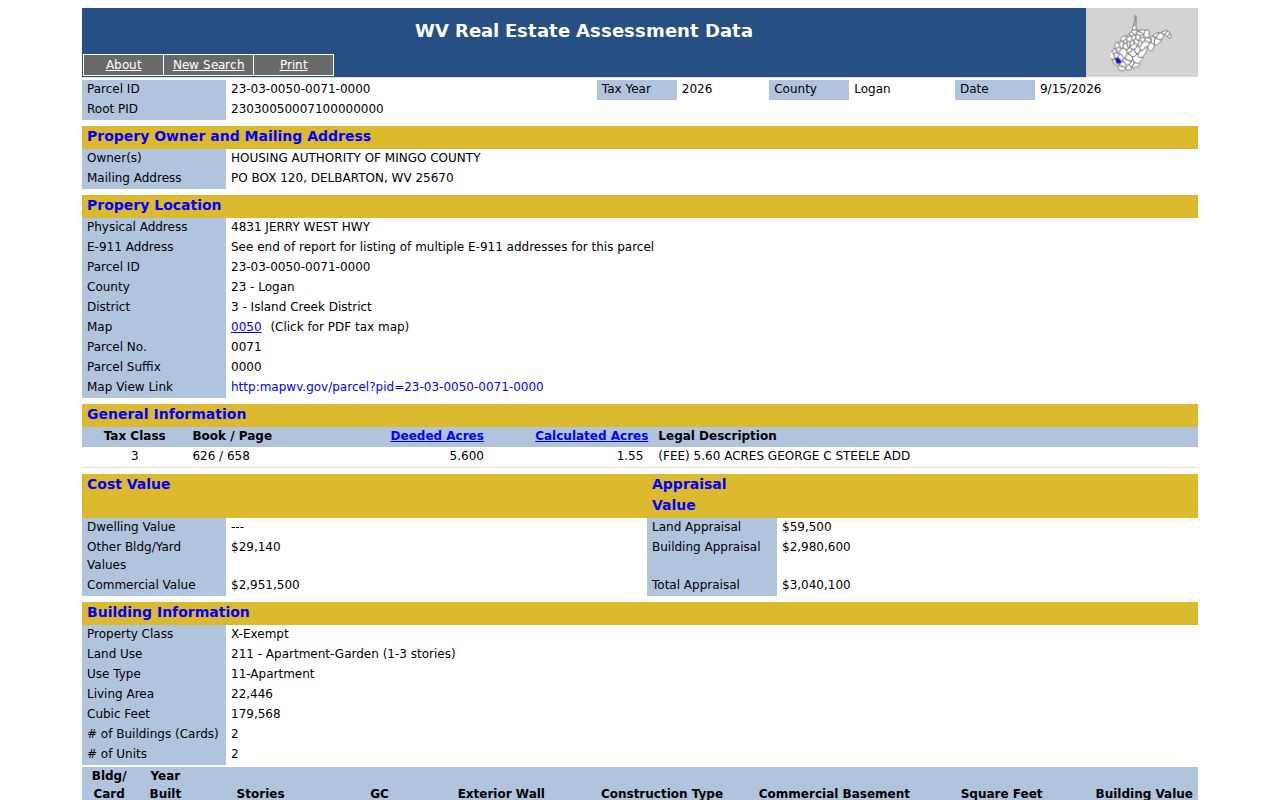
The Mingo detail shows land, building, and total values side by side.
Look Up a Mingo Assessed Value
The IAS assessment search finds a property by E-911 address, owner, property-address text, or parcel attributes. The value belongs to one parcel. It also belongs to one tax year. A full address sometimes fails, so try the street name instead. Mingo address text can be incomplete. Confirm the legal description before comparing a value. The mailing address can sit in a different town from the physical parcel.
- Search the Mingo parcel in IAS by address, owner, or parcel number.
- Confirm the physical location and legal description match the property.
- Read the tax year and separate land, building, and total values.
- Use the deed index for transfer consideration if it appears in a recorded instrument.
- Ask the assessor about a disputed assessment or a missing detail.
- Assessed value
- The figure used on the tax roll under state law.
- True and actual value
- The underlying standard to which the state assessment percentage applies.
- Consideration
- Value stated in a deed for a transaction, when shown.
- Assessment ratio
- The share of the underlying value used for assessment; West Virginia generally uses 60%.
Mingo Deeds Show a Different Value
Deeds and assessments answer different questions in Mingo County. The IAS parcel detail lists annual land, building, and total assessment amounts. The deed, by contrast, records a conveyance and may state a consideration. No sale-price field appears in the Mingo sample assessment. When a deed states an amount, read the context and the legal description first. The consideration does not automatically equal an open-market value. Nor does it equal the value of every right in the tract.
Surface and mineral rights can separate in Mingo County. So one parcel outline may not show every interest. The deed description controls what the instrument conveys. For an older transfer, check the clerk's index. Ask about the associated image or book record. Never treat the current assessment total as the price a buyer paid. A single historic deed is no substitute for today's appraisal either.
Exemptions Change the Taxable Picture
Exemptions work differently than many owners expect. A homestead exemption can lower the taxable amount. But the land and building values on the roll stay the same. Homestead and other exemption questions belong to the Mingo County assessor. That office can confirm which exemption applies to a given owner and tax year. It can also explain the forms, deadlines, and proof required. Never assume an exemption travels with a parcel after a sale.
The assessment itself is just one input. A Mingo County tax ticket also reflects levies, relief, and any unpaid balance. The county publishes no verified online ticket link. So ask the sheriff about bills and payment. Ask the assessor for a roll value correction or an exemption fix. Bill details and appeal deadlines sit outside what a property value alone can tell you.
Mingo Value Studies Are Not Parcel Appraisals
The West Virginia Tax Division publishes ratio studies along with trend and depreciation tables. County-district materials from that office describe how assessments are built in the aggregate. They do not estimate what a specific Mingo County parcel would sell for. Mingo publishes no confirmed county revaluation year or town-level value trend. Use the current IAS detail for the roll amount. Then ask the assessor how that number was set.
A number that looks wrong deserves a careful comparison first. Check that the tax years match. Separate land from building components before acting. A ratio study cannot capture every building condition or legal description. It also misses split interests and recent transfers. For an assessment review, gather parcel-specific evidence and file with the assessor. For a sale or financing question, hire a qualified appraiser. For the tax amount due, contact the sheriff instead of estimating from the assessment.
What a Mingo Assessment Cannot Predict
A Mingo County assessment is a tax record, plain and simple. It is not an offer, a forecast, or an appraisal. The statewide assessment method applies. The valuation date can differ from a recent listing or transfer. The IAS detail page shows no field for sale consideration. A real transaction may involve different parcel boundaries. It may also involve split mineral and surface interests. One map shape does not always suggest those details.
Match the record to the question at hand. The deed records show the recorded conveyance. The assessor explains the roll and the valuation behind it. The sheriff confirms the tax bill. A qualified appraiser gives an independent opinion for a purchase, estate, financing, or dispute. The GIS viewer helps orient the parcel. Boundary questions turn on the legal description and a survey.
Value vs price. The Mingo assessed value is for the tax system and is not what a property will sell for. Use a qualified appraiser when a market opinion is needed.