
Mingo Deed Records and Related Instruments
Deeds are only part of what the Mingo County Clerk records. The land-record list also covers conveyances, deeds of trust, liens and judgments, releases, assignments, agreements, affidavits, plats, cemetery deeds, church-trustee records, and trustee reports of sale or foreclosure. Military discharges are on the list too, though access is restricted. Each instrument type signals a different legal act. A deed conveys an interest in land. A deed of trust secures a debt. A release clears an earlier encumbrance, and a plat maps a recorded division. Always read the document itself before trusting its label.
| Deed Type | What It Does | Common Use |
|---|---|---|
| Deed of conveyance | Records a transfer of an interest in land | Confirm grantor, grantee, description, and recording reference |
| Deed of trust | Records a security interest tied to a loan | Follow lender, trustee, assignments, and later release |
| Release or assignment | Updates an earlier recorded lien or obligation | Read with the original instrument and parcel description |
| Plat or map | Records a mapped division or land description | Compare its lot reference with the deed and GIS |
| Trustee report of sale | Documents a trustee sale or foreclosure filing | Check the related case and later deed or confirmation |
A deed and an encumbrance can share the same parcel history. But they do very different work. The deed names a grantor and a grantee. A deed of trust names the borrower, the lender, and a trustee. It may later be released or assigned. A lien can cloud title without ever changing the assessor's owner-of-record field. When a record crosses from the assessor to the clerk, copy the parcel detail's book and page plus the legal description. Then match those identifiers against the recorded instrument. The Mingo source index publishes no cutoff year. Older records may still call for counter or archive research.
The Mingo Online Index Has a Coverage Gap
The county's public land-record page confirms which instruments Mingo records and gives a starting point for the deed index. Details of the live search, including party-name rules, the earliest year, imaging cutover, image cost, result limits, and login requirements, must be confirmed with the clerk. The online index should not be described as complete to any particular year. Nor can anyone promise that a deed image is free to view.
If the online name or parcel search comes up empty, bring the legal description, the book and page if known, the owner names, and a date range to the county clerk at the Mingo County Courthouse. Ask whether the record sits at a public terminal, in a deed book, on microfilm, or behind a copy request. Mingo County began in 1895. A chain predating the county's organization may continue in an earlier jurisdiction or in state and federal land sources. The clerk or an archive can confirm the first Mingo deed book and what survives of the earliest holdings.
Open Mingo County's land-record page for the current entry point and the recorded document categories.
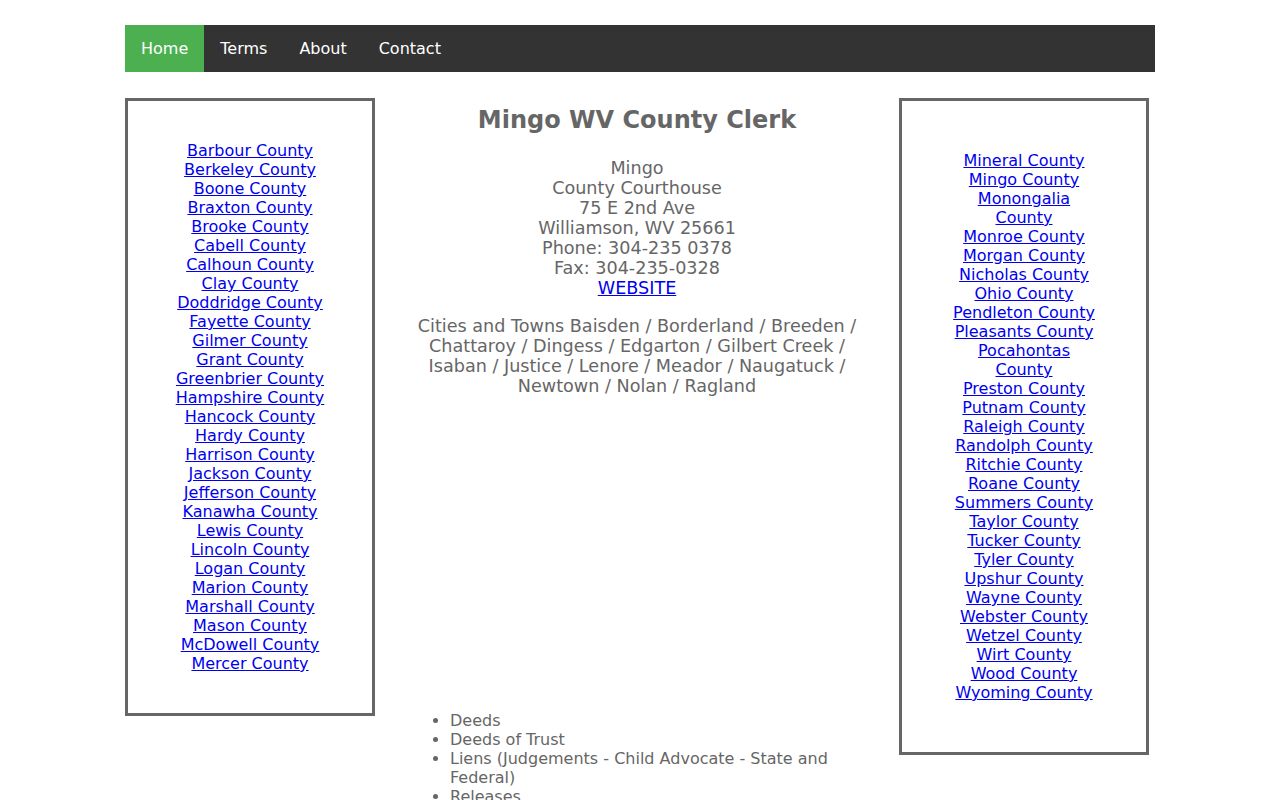
Think of the landing page as a directory. The clerk confirms access to any individual record or image.
Fields to Prepare for a Mingo Deed Search
Treat these as search clues, not promises about the current screen. The live form labels and match behavior can change. A name search works best when you try both party roles. Legal-name variants help too. A date range can narrow the clerk's records. A document category can help when the system supports those filters.
| Search clue | What to supply | Known status |
|---|---|---|
| Grantor / party | Prior owner or party transferring an interest | Index is grantor-grantee oriented; exact partial-match rules unknown |
| Grantee / party | Recipient name, including initials or entity variants | Search form label and name order not verified |
| Document type | Deed, trust deed, lien, release, plat, or other category | County category list is known; live options unknown |
| Recording date | Approximate or bounded date range | Coverage dates and control type not verified |
| Book/page or instrument | Assessor reference or a known clerk ID | Whether both are searchable online is unknown |
| Parcel/map reference | District, map, parcel, or suffix where known | Portal field availability not verified |
The reliable fallback is simple: ask the clerk how the current index handles names and which reference works best for an older deed entry. Write down your search terms and the date you used them. That note keeps a second attempt from repeating the same miss.
Tracing a Mingo Grantor-Grantee Chain
A grantor conveys the interest. A grantee receives it. The chain of title is the ordered set of recorded instruments linking one owner to the next. Building it is mostly repetition. Start with the assessor's book and page reference from the property detail. Find the current vesting deed and read both names on it. Then search backward for the instrument by which that grantor first acquired the land. Keep repeating until the chain hits a known boundary. It may also stop at the county's 1895 formation, or at a record set that needs archive help.
- Use the assessor book/page or current owner to find the most recent recorded conveyance.
- Copy its recording reference, legal description, grantor, grantee, and date.
- Search the grantor as a grantee in the earlier transfer, allowing for initials and name changes.
- Check liens, releases, assignments, probate deeds, trustee sales, and plats that affect the same land.
- When the online trail stops, ask the clerk or archive about deed books and older indexes.
- Grantor
- The party named as transferring an interest in the instrument.
- Grantee
- The party identified as receiving that interest.
- Chain of title
- The sequence of recorded transfers and related instruments for the land.
- Book and page
- A volume and page reference shown on the Mingo assessment detail; confirm it with the clerk.
Mingo's Copy Fees Come from State Law
West Virginia Code §59-1-10 sets the county clerk's recording and copy fees statewide. Recording a deed of conveyance or deed of trust costs $30. A trustee's report of sale with the required added filing details is $40. A plat or map without a deed runs $10. An ordinary financing statement costs the same. Another ordinary writing does too. The same statute lists extra-page charges and copy costs. So ask the clerk which category fits your document before sending payment.
The state schedule also includes $1 for each page over five pages on certain recording filings. It lists $1.50 for a copy of a writing. It adds $1 for each additional page where that copy provision applies. Separate seal and electronic-copy rules apply too. The statutory category matters. A certified copy, an electronic image, and a plain paper copy may fall under different provisions. The amount on a current counter invoice depends on what is filed or copied.
Read W. Va. Code §59-1-10 and confirm the exact charge with the Mingo County Clerk.
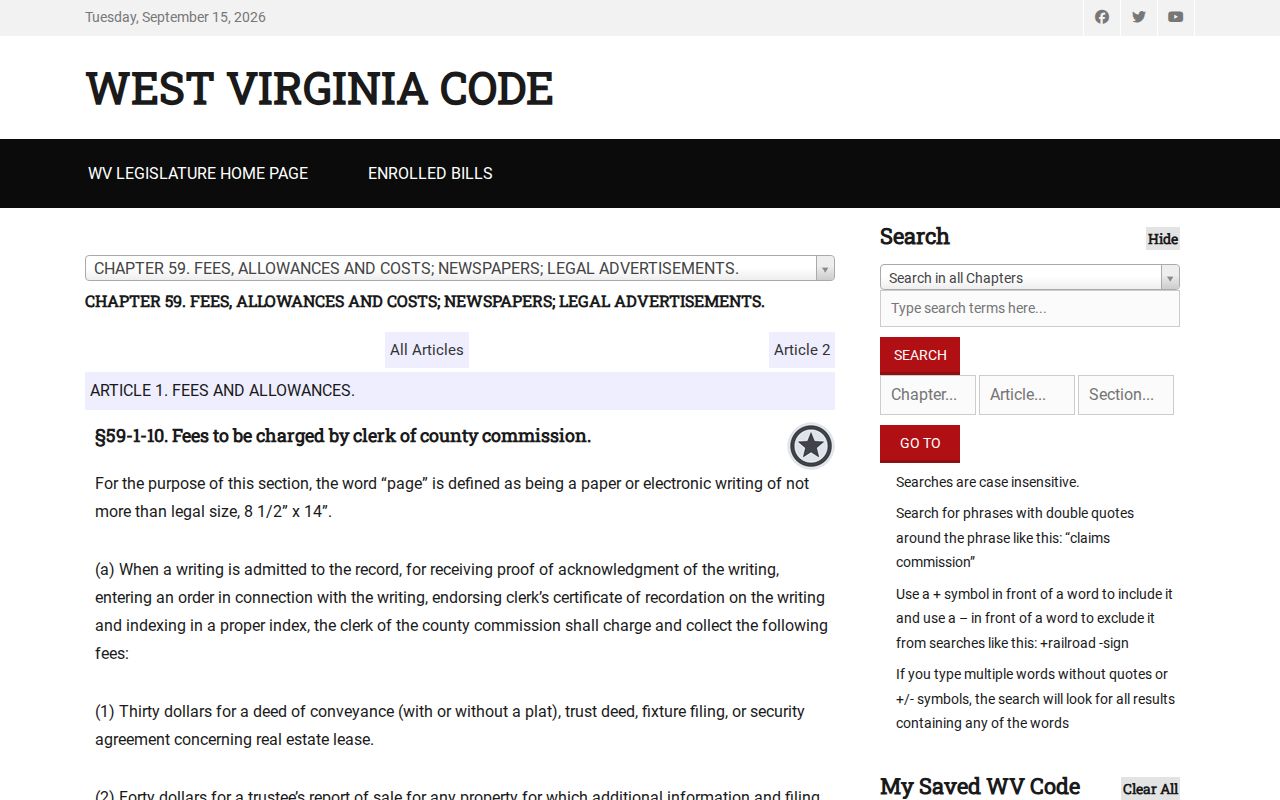
State law sets the statutory copy fees, and the clerk can quote your exact cost.
Older Mingo Deeds Need a Wider Search
Mingo County dates to 1895. Anything older belongs to another story. A pre-1895 deed trail can run through a parent county's books or through state and federal land records. Coal-era land adds a twist. Surface rights and minerals were often split apart, so one parcel outline can hide several recorded interests. Read each legal description instead of assuming a single deed conveys every right.
For older West Virginia material, the State Archives and History Library is the standard referral. Mingo County's library system can help too. So can the Mingo County Genealogical Society and the Mingo County Historical Society. These groups can point you toward local newspapers, old maps, and family files, so give the town, road name, former owners, and rough era when you ask. A newspaper can explain a place name. Only the clerk's record proves a deed was recorded.
Death often changes the owner of record. Search the grantor-grantee index under the decedent, estate, executor, administrator, and trustee variants. A court file may hold a will or an appointment paper, yet the final conveyance still needs its own confirmation. A death certificate proves vital facts, not ownership.
Mingo Court Files Add Foreclosure Context
Foreclosure and lien disputes often leave a paper trail in court as well as in the land records. Mingo Circuit Court sits in the 11th Circuit. Its statewide search tool, WVPASS, launched in 2025. Downloads may require registration plus a nominal fee. A docket there can show a case number, the parties, status, a judgment, lis pendens, a sale order, or a final decree. For archived papers and certified copies, contact the Mingo Circuit Clerk.
The Magistrate Case Record Search is free and statewide. It works by name or case number and caps results at 30. The documents themselves stay offline. Property-related small claims may appear, though not every lien becomes a magistrate case. A docket is not proof of title. Match the parties and the parcel description against the clerk's recorded documents, or use the West Virginia court-record access page to reach both search routes.
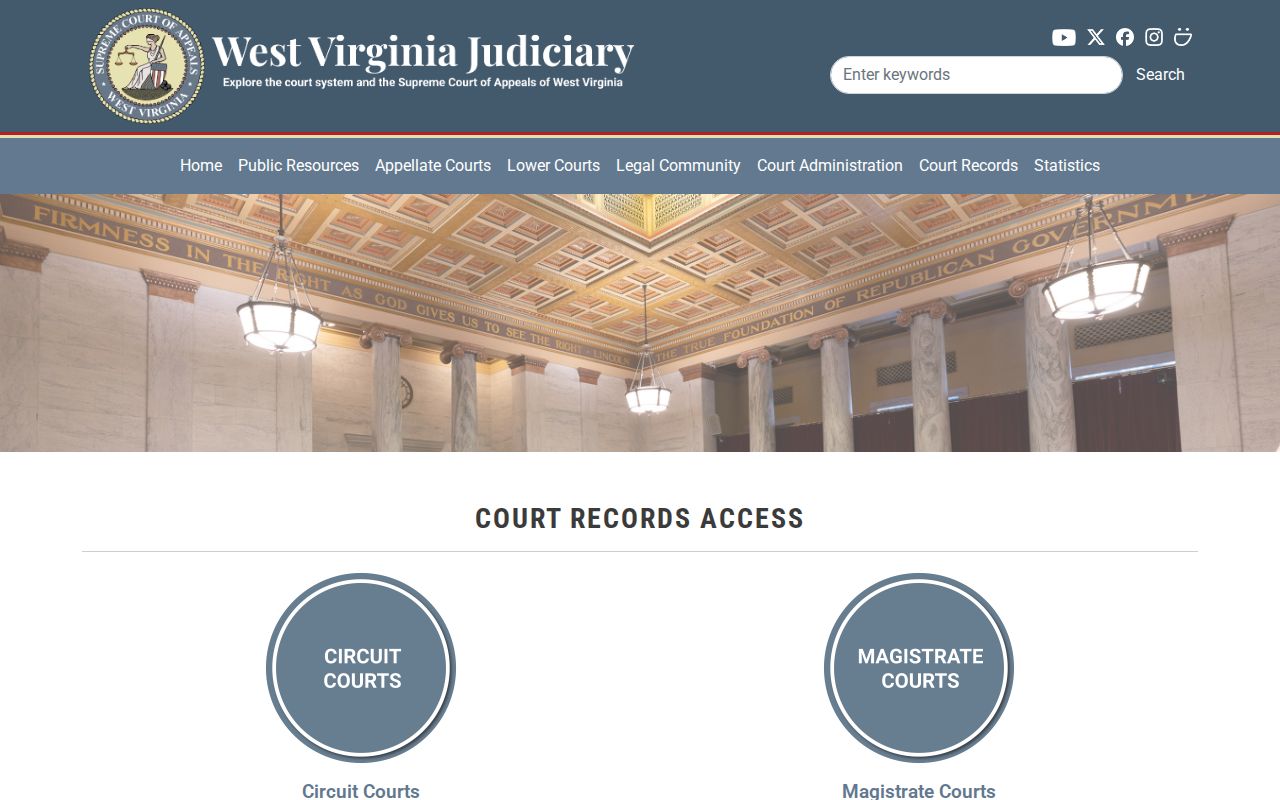
The case papers themselves come from the proper clerk. Open the free West Virginia Magistrate Record Search to run a name or case-number lookup.
A search here can surface a useful docket. For certified document copies, the Mingo clerk remains the official source.
Requesting a Mingo Deed Copy
Start with the instrument reference from IAS or the clerk's index. Write down the grantor, grantee, recording date if known, book/page or instrument number, and full legal description. Then ask the Mingo County Clerk which options are available for the record: public index, on-site lookup, plain copy, certified copy, or an electronic copy. The online landing page does not settle image access or the earliest online date, so direct confirmation is important. If the search is older than the index, ask whether a deed book or archive series can be checked.
The clerk's office is at 75 E. 2nd Avenue in Williamson. Phone 304-235-0378 and fax 304-235-0328 are listed in the research. When requesting a copy by mail or phone, provide a return address and a way to contact you about the statutory fee. Do not assume that paying a filing fee for a newly submitted document is the same as paying for a copy of an existing deed.
A clear request also helps distinguish the deed from related records. If a transfer followed a trust deed, foreclosure, probate action, or partition, ask for the linked instrument or case reference. For deeds that predate 1895, explain that the Mingo chain may point to an earlier jurisdiction and request guidance before assuming the county's current index will contain it.
Recorded, not guaranteed. The Mingo deed index shows recorded instruments and can miss unrecorded interests or later changes. A complete title review requires the relevant records and professional examination.