
Find a Mingo Owner from an Address
Finding a Mingo County owner is a chain of checks rather than one name search. Begin with the exact physical address in West Virginia's IAS assessment system. If the E-911 search misses, try the property-address field using the street name alone. Stored text is sometimes incomplete. Write down the parcel ID, owner, mailing address, physical address, legal description, and book/page. Then pull the newest conveyance from the Mingo County Clerk's land-record index. Compare the grantor, grantee, date, and description against the assessment record.
That comparison settles the who-owns question. It works far better than a map label or a mailing envelope. An LLC, estate, or trustee needs to be searched under its exact legal name. Known variants should be searched too. A tax roll names an owner of record for assessment purposes. A recorded deed proves a conveyance. Neither record alone resolves every interest. For a sale that just closed, check the newest clerk filing first. The assessment roll may still show an earlier tax-year snapshot.
- Search the full E-911 address in IAS, then try the street name if needed.
- Copy the parcel ID, owner field, mailing and physical addresses, legal description, and book/page.
- Search the county clerk's deed index for the latest conveyance to that grantee.
- If a company appears, check its official state business filing and compare the exact entity name.
- Ask the assessor or clerk about a mismatch instead of treating one screen as final title proof.
Keep Mingo Situs and Mailing Addresses Apart
A mailing address and a physical address answer different questions. The owner may receive an assessment notice at a post-office box. The land may sit on a road or in an addition miles away. A city name on the mailing line proves nothing about boundaries. It does not show the parcel lies inside city limits. Nor does it prove the town's tax district or the ZIP geography. Mingo's state records make the point clearly. One sample detail lists a Delbarton mailing address beside a legal description for 5.60 fee acres in George C. Steele Addition.
Record both address fields when you identify an owner. Then use the legal description and parcel ID as the bridge between them. If an address search fails, IAS recommends a street-only search for incomplete property-address text. The E-911 search suits a full site address. It will not accept a rural route or a post-office box. Never treat a mailing location as the owner's home or as proof anyone lives there.
Where Mingo Owner Names Appear
The assessment roll and the clerk deed index signal ownership differently. IAS carries the assessor's owner field, mailing address, property description, values, and book/page. The clerk's recorded instrument instead names a grantee and documents the conveyance itself. The GIS viewer can display a parcel owner and physical address. It may show only one of several owners, though. A state business search explains an entity's filing details. Only the land record ties that entity to the parcel.
| Source | Owner Info It Gives | Access |
|---|---|---|
| IAS assessment detail | Owner, owner address, situs, legal description, values, and book/page | State assessment search |
| Mingo County Clerk | Grantee and grantor on recorded conveyances and related instruments | Online landing page; ask about index images and copies |
| WV business search | Entity status, filing dates, registered agent, principal office, and filings | Official state business system |
| WV Property Viewer | Parcel geometry, owner display, address, and basic assessment links | Statewide GIS viewer; may show one owner |
"Owner of record" means the name a given record system carries. It is not an occupant. It is not a property manager, and it may hide beneficial interests behind an entity. A grantor conveys the property. A grantee receives the interest named in a deed. Estates and trusts can put names on a deed. Those names may differ from the previous tax roll entry. The current owner is settled by the newest recorded conveyance plus a roll cross-check. A map label alone settles nothing. To pin down the present assessment name, compare the IAS record card with the most recent county-clerk deed. The page on the Mingo current owner of record walks through that present-tense cross-check.
Checking a Mingo Business Owner
When IAS lists a company, copy the entity name exactly. Then run it through the West Virginia Secretary of State Business & Licensing system. The state filing shows whether the entity is active. It also gives its formation date, registered agent, principal office, and filed documents. Those details help separate two companies with similar names. They can also reveal the address used for legal notices. The business record alone does not prove the company holds a particular parcel. Compare it with the grantee named in the Mingo deed.
Use the land-record legal description to confirm the property. This matters most when an entity owns several tracts or has changed its name. A trust, trustee, personal representative, or estate may appear in the conveyance too. Search every name variant in the instrument. Follow any assignment or release tied to the same land. Open the West Virginia business search. It checks an entity name in the official state system.
Use the entity filing to understand the name. Then return to the Mingo clerk's deed for the parcel-ownership evidence.
Mingo Estates May Use Several Names
A death sets off paperwork. Deeds, court orders, partitions, and affidavits may all carry the estate forward. The names rarely match from one document to the next. Search for the decedent and the estate itself. Search the executor or administrator, a trustee, and any heir or devisee. Each role can appear in a different instrument. The county clerk records estate papers. The circuit clerk keeps the court file covering appointments, wills, inventories, sale authority, and final accountings. Keep one caution in mind. A will alone proves nothing about whether a parcel was conveyed.
State Vital Registration issues death certificates, but those records establish vital facts, not land ownership. Certified copies carry eligibility and identification rules. For older genealogy, the state archives and local library are better stops. Any Mingo owner lookup should end by tying the transfer to a parcel description. Match it against the assessment record.
A Mingo Map May Omit Co-Owners
The state property viewer is handy for confirming where a parcel sits. Its own caution is that a mapped result can list a single owner even when several hold title. Stacked parcels may only open a popup with arrows. Missing geometry can leave a parcel without a drawn shape. Treat the owner shown on the GIS map as a clue. Then go back to the assessment site and the clerk's recorded instrument for the complete owner and grantee names. The map earns its keep when one road crosses a town line. It also helps when a mailing city disagrees with the parcel's physical address.
After a recent sale, lean on the newest recording date and deed. Do not assume the tax roll catches up instantly. The state's tax cycle keys ownership, use, and value to a July date. So the assessment can be right for a prior tax year yet differ from a newly recorded grantee. Ask the assessor when a change lands on the next roll.
Review the Mingo owner and parcel detail to see how an owner, owner address, legal description, book/page, and tax-year history fit together.
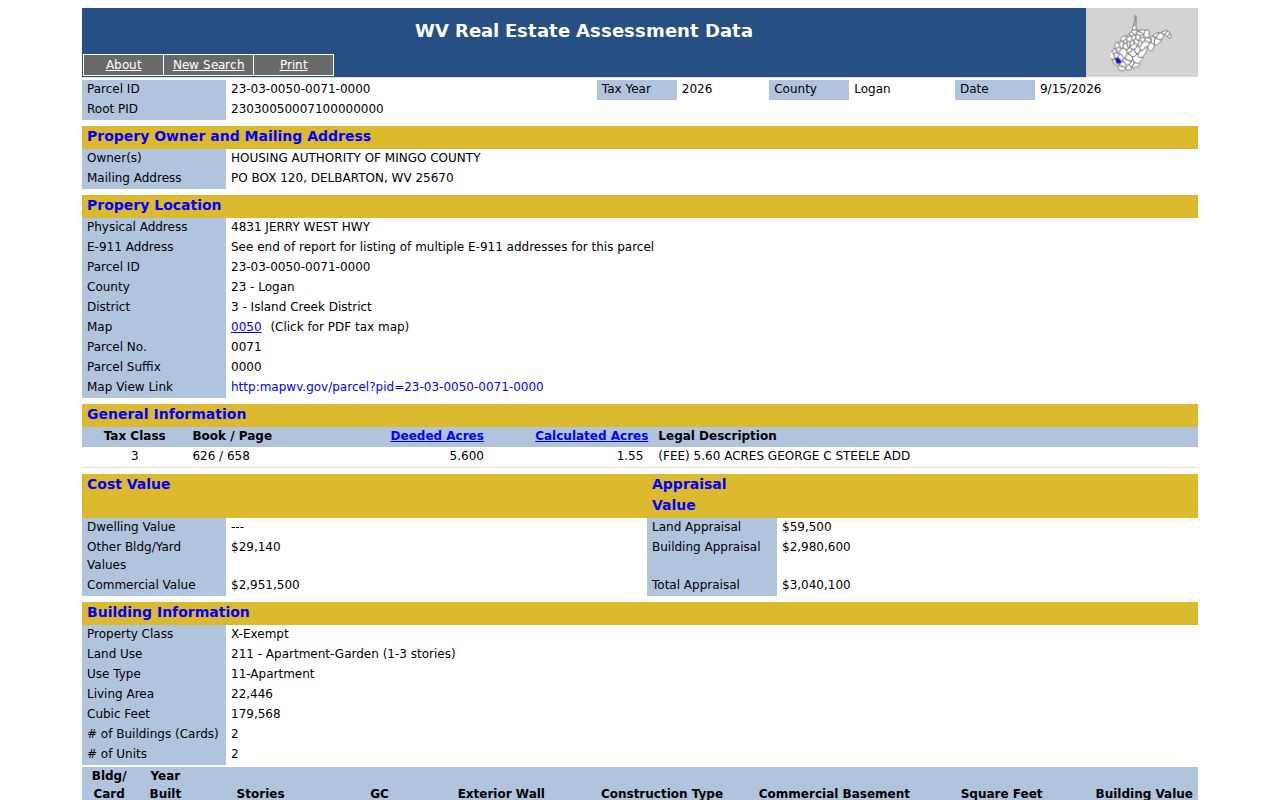
Note: The sample illustrates the record fields; check a separate current parcel for a current owner answer.
Request a Mingo Owner Record Directly
Sometimes the online assessor detail or deed index simply does not settle an ownership question. Then contact the office holding the record. Provide the address, the parcel ID, and a book and page if known. Include the exact record type. West Virginia FOIA lets any person make a reasonably specific request to a public custodian. The office must respond within five days, excluding weekends and legal holidays. Copy costs may apply. Staff search time cannot be charged.
A public-record request is not a request to identify a resident. Military discharges sit in a restricted category on the clerk's list. Sealed court matters and confidential vital records carry their own limits. Ask what can legally be released. The goal is to match the property record to the deed. Do not infer who lives at an address.
Limits on a Mingo Owner Lookup
A public owner name tells you who holds record title. It does not tell you who lives there or who is present today. It is a recorded or assessed name tied to a parcel at one point in a tax or filing cycle. A Mingo who-owns search also cannot promise that every co-owner or unrecorded interest surfaces in the first result. Estate claims and private agreements may stay hidden too. Protected addresses, sealed cases, confidential vital records, and restricted military discharges are not ordinary open records.
Lawful use. Use Mingo owner data for property due diligence, estate work, boundary research, and civic purposes. Do not stalk, harass, intimidate, or harm anyone; seek custodian help if a protected record or address is involved.