
The Mingo Owner-of-Record Card
Think of the assessor's IAS detail as the roll card for a Mingo County tax parcel. The owner field sits beside the owner address and physical address. The legal description, tax year, and book/page sit nearby too. Read them together.
That roll name is the assessor's owner-of-record display, nothing more. It does not promise the last deed is indexed. A map result may leave co-owners off the screen. If the property changed hands recently, let the deed's recording date tell you which record is newer.
| Owner | Name carried on the assessment roll for the stated tax year |
|---|---|
| Owner address | Mailing address used for assessment notices; may be a P.O. box |
| Physical address | Situs or E-911 location tied to the parcel |
| Legal description | Land description used to match the record to a deed or plat |
| Book/page | Clerk reference shown on the inspected Mingo assessment detail |
| Tax year and history | Assessment period and prior values; not a live transfer date |
An owner-of-record name is not an occupant field. The mailing address exists to route an assessment notice. It can sit far from the land itself. A Delbarton post-office box in the sample record shows that split clearly. Keep the two fields separate when matching a Mingo parcel. Never infer residence, possession, or where a person lives today from the assessment card.
Review the Mingo owner record. It shows how owner, owner address, book/page, description, and yearly values appear on the official detail page.
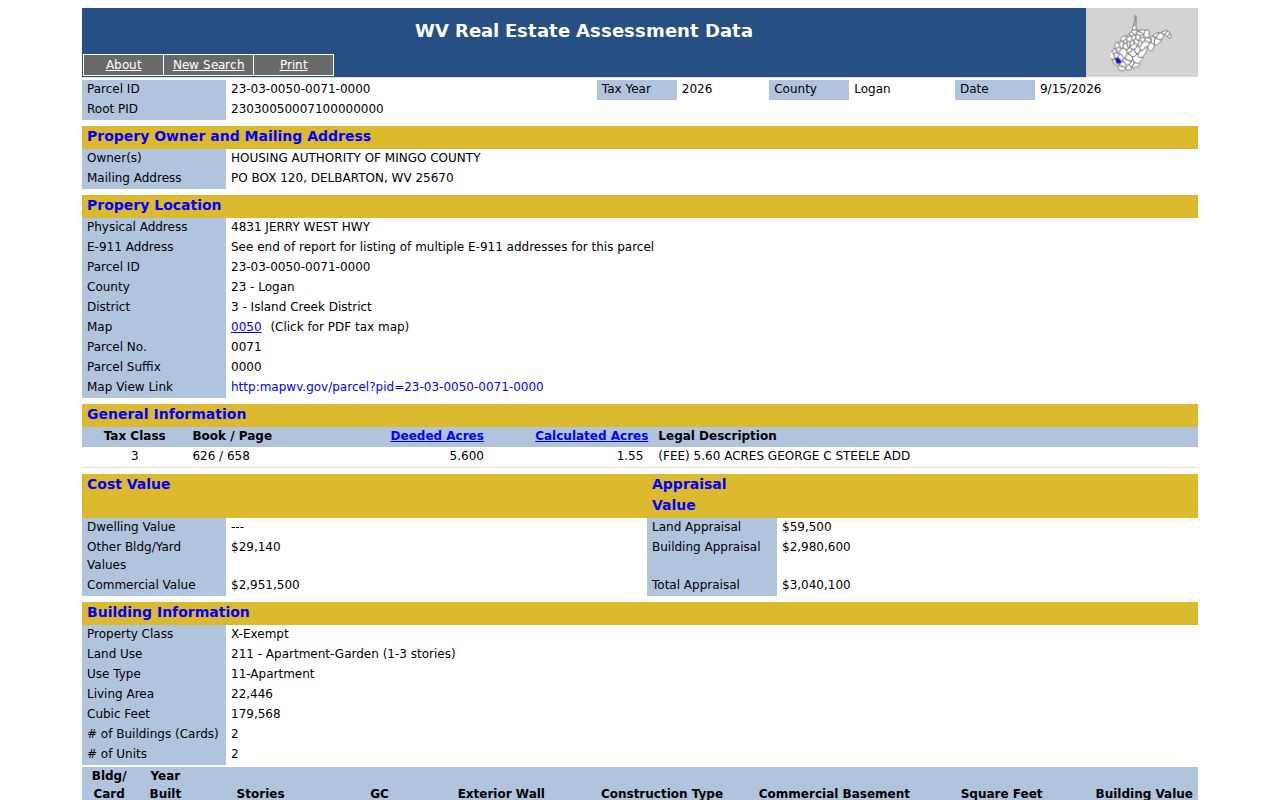
The sample serves as an interface example only, and it says nothing about any other parcel's owner or present status.
What the Mingo Roll Calls Current
West Virginia assesses ownership, use, and value each July 1 for the tax year. The IAS detail may list rows across several years. Still, it is not a live log of deeds filed after that date. Mingo's exact lag between a sale and a roll update was not established. So a new buyer should compare the current tax-year owner of record against the latest recorded conveyance. Do not assume the roll flipped on closing day.
When the two records disagree, pull the deed. Read the recording date, legal description, grantor, and grantee. If that instrument is newer and describes the same parcel, call the assessor and ask when the tax roll will update. Estates, trusts, companies, and multiple grantees can all appear as the owner of record. So take the names exactly as written. Note which office and date each record reflects. Never blend one into the other.
Mingo Situs and Owner Mailing Fields Differ
The physical address locates the real property. The owner address is simply where mail goes. In Mingo, one might be a rural road or town-site description. The other could be a box in Williamson, Delbarton, or somewhere else entirely. E-911 address search will not accept a post-office box or rural route. IAS address text can run incomplete too. Fall back on the street name when a full address misses.
For a current-owner check, record both fields beside the full parcel ID and legal description. A mailing city settles nothing about city limits, ZIP boundaries, tax district, or occupancy. The map viewer helps orient the situs. One record can display a single owner while multiple parties hold title. That is why an accurate answer rests on parcel identity and deed confirmation. The mailing city alone will not carry it.
Confirm the Current Mingo Owner
Start with the assessor roll. Then verify present vesting in the county clerk's newest recorded deed. Book/page 626/658 in the sample shows the link. An assessment detail can point to a clerk record. Treat it as a reference, not a substitute for reading the instrument. A title chain can hold a trust deed, release, assignment, estate transfer, or trustee report. Check each record that changes or burdens the parcel.
- Copy the owner, tax year, parcel ID, legal description, and book/page from IAS.
- Search the Mingo clerk's index by the roll owner's name and the prior grantor where known.
- Read the latest deed and compare its property description with the IAS parcel.
- If the roll is older, ask the assessor whether a deed update is pending for the next assessment cycle.
For a one-step ownership method from an address, the Who Owns This Property page explains how IAS, the clerk, and map records fit together.
Verifying the Mingo Owner on a Deed
A deed's grantee line records who received the described interest. The assessor's owner field carries the name used on the roll instead. Compare the names, the legal description, and the filing date. If anything mismatches, search the clerk index for later instruments. Ask the clerk whether an image or book record requires an in-person check. The online index cutoff and image coverage are not published. A missing web result never settles the question.
- Read the current tax-year IAS owner field and capture the parcel identity.
- Use the book/page or owner names to locate the latest deed in the Mingo index.
- Match the grantee and legal description to the same parcel, not just a similar name.
- For an entity owner, check its state filing and keep that result separate from the deed.
- Owner of record
- The name on a specific assessor or recorded instrument.
- Situs address
- The physical location of the parcel.
- Mailing address
- The address used to send assessment or tax mail.
- Recording lag
- The interval between a deed filing and its appearance in another system; Mingo's duration is not published.
Entities and Estates on Mingo Records
An owner of record in Mingo County can be an individual, an LLC, a trust, or an estate. Names vary. When the assessment names a business entity, the West Virginia business search lists its status, formation date, registered agent, principal office, and filings. Those fields pin down the exact legal name. The Mingo deed then settles the question, because the grantee named there is who took title to the parcel. One caution applies. A registered agent is only a service contact, and that listing alone proves nothing about who owns or occupies the land.
Estate names call for extra care. If a decedent's name sits on the record, search for the estate, executor, administrator, or trustee as well. The circuit clerk may hold the probate file. The county clerk records later instruments. A will or an appointment explains who has authority, but it never shows a finished conveyance by itself. Tie the final deed or court order to the parcel description before drawing any conclusion.
Mingo Owner History Follows Tax Years
The IAS detail lets you flip through several assessment years. One Mingo record displays tax years 2022 through 2026. The owner, book/page, and legal description stay the same while building and total values shift. That table is not a deed timeline. It simply shows what the tax roll carries year by year. It cannot prove that no transfer or correction happened outside the rows on the screen.
For a true current-owner check, compare the newest roll year against the most recent recorded deed. If the deed is newer, ask the assessor when the assessment file will catch up. Mingo County publishes no fixed update lag. Steer clear of any estimated number of days. Keep the transfer date and the assessment year separate in your property file.
Responsible Use of Mingo Owner Data
Mingo County parcel records serve real purposes. Property research, purchases, estate administration, tax review, and civic questions all fit. They do not show who is home, and they do not invite unwanted contact. Some material stays restricted: military discharges sit on the clerk's list with limited access, vital records carry confidentiality rules, and sealed court matters are not ordinary public records. West Virginia FOIA adds its own statutory exemptions. If something sensitive appears, ask the custodian about a redaction rather than piecing together a protected address from another source.
Lawful use. Use the Mingo owner record for a property matter and respect privacy limits. Do not use a name, mailing address, or parcel detail to stalk, harass, threaten, or harm anyone.